
Blog · 2026-11-19
How Dryer Vent Length Quietly Raises Your Energy Bills
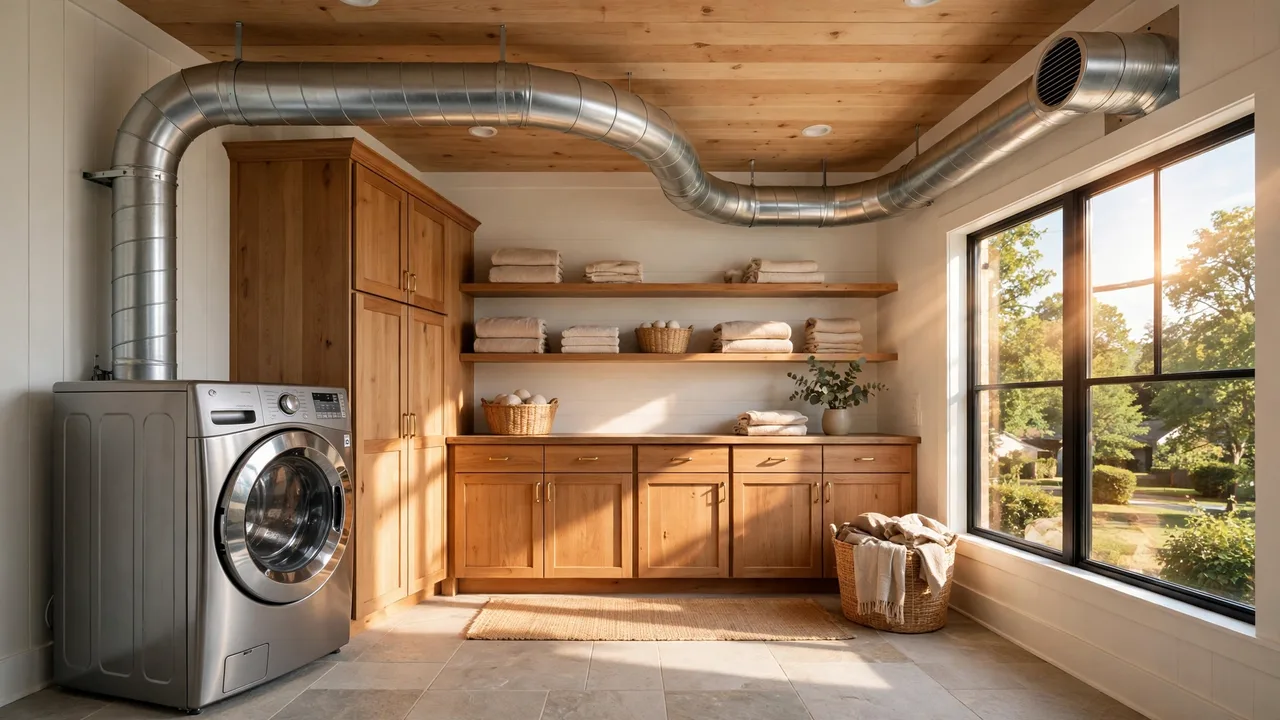
The fast answer: the longer and more twisted your dryer vent run is, the harder your dryer has to work on every single load — and you pay for it in longer run times, higher energy use and faster wear. A short, straight, clean vent lets hot, moist air leave quickly. A long vent full of bends, sags and lint holds that air back, so clothes stay damp, cycles stretch, and the meter keeps turning for heat that is not drying anything.
Why your energy bill is really an airflow bill
A dryer does not dry clothes with heat alone. It heats air, tumbles that air through wet fabric, and then has to push the air — now heavy with moisture — all the way out of the house. Heat is only half the job. Airflow is the other half, and airflow is what vent length takes away. Every foot of duct adds resistance. Every elbow adds more. By the time exhaust has travelled a long, bendy route to a roof exit or a far wall, it may arrive as a weak trickle instead of a strong stream. The dryer keeps heating while that moisture struggles to leave, and that extra running time is where the energy goes — load after load, in homes across Maryland, DC and Northern Virginia.
How length and bends quietly add up
Most homeowners never chose their vent route. The builder did, and builders often put the laundry room where it fits the floor plan, not where the vent exits easily. Add the elbows needed to turn corners and climb, a sagging section that collects condensation, and the ribs of flexible hose that slow air at every ridge, and a run that looks fine on paper fights the dryer on every load. It shows up not as a breakdown, but as towels that are never quite dry in one cycle and a habit of simply pressing start again.
The second-cycle habit is the real cost
The clearest sign length is taxing you is not the vent itself. It is the second cycle. One extra run for towels, another for jeans — each of those minutes is electricity or gas spent re-heating clothes that should already be dry. It is also wear you cannot see: heating elements, thermostats, belts and motors age in run time, so a dryer that works twice as long on every load spends its working life twice as fast. According to the U.S. Fire Administration, clothes dryers are involved in thousands of fires in American homes every year, and failure to clean is the leading factor. A long, restricted vent is not just an energy problem. It is the same system, asking for attention on two fronts at once.
Long run, clogged run — or both? How to tell the difference
Lint is always the first suspect, and it should be checked first. If drying has slowly worsened over months, if the outside flap barely moves, or if the laundry room turns hot and humid, a clogged line is likely and a full-line cleaning is the place to start. Distance leaves a different fingerprint: drying has been slow for as long as you have lived in the home, it stays slow even right after a cleaning, and heavy loads suffer most because they hold the most moisture. Many homes have both at once — a long run that also loads with lint faster because air moves slowly through it. So do not guess. Clean the line, measure the airflow at the outside cap while the dryer runs, and then judge what is left. If a clean, sound line still cannot move air, the route itself is the conversation.
What actually brings the cost back down
Start with the free and simple habits. Clean the lint trap after every load, and wash the screen with warm soapy water if water pools on it instead of passing through, because fabric-softener film can coat the mesh. Keep the hose behind the dryer from being crushed when the machine is pushed back. Then fix the line itself. A full-line cleaning removes the lint coating that narrows a long run even further. A crushed, separated or plastic section is a repair to make while the line is open. If the route doubles back, sags, or climbs when a shorter exit exists nearby, rerouting the vent can solve the problem at its root — shorter, straighter, smooth metal, properly supported, ending at a working exterior cap. When there is honestly no shorter path, a dryer-rated booster fan in the line can give the exhaust the extra push it needs. The cap matters too: it should swing wide while the dryer runs and close when it stops, protected by a dryer-vent-rated bird guard, never a fine screen that clogs with lint.
How we check it: visual, airflow, and a straight answer
Our lint and fire-hazard inspection is visual and airflow-based only. We look at the connection, the duct material and joints, the length and routing, and the exterior cap, and we measure airflow at the outside vent while the dryer runs. We do not claim lab testing. If the line needs cleaning, you will see why. If the route is too long or badly bent, we will explain the options — cleaning, repair, rerouting or a booster fan — and which one honestly fits your home. And if the vent is breathing well, we will tell you that too.
If your dryer in MD, DC or VA takes two cycles, your laundry room runs hot, or that outside flap barely moves, do not just accept the extra running time as normal. Call Eagle Dryer Vent Cleaning at (855) 640-0404 — answered 24/7 — or send the lead form on this site and we will call you back to confirm a time to clean the line, measure the airflow, and show you what your vent is really costing you in time and energy.
Want us to check your vent?
Book a cleaning or a fire-hazard inspection — airflow measured, evidence shown, straight answers.