
Services
Dryer Vent Repair
Disconnected, crushed or leaking vent lines found and fixed — joints re-sealed, damaged sections replaced, airflow restored.
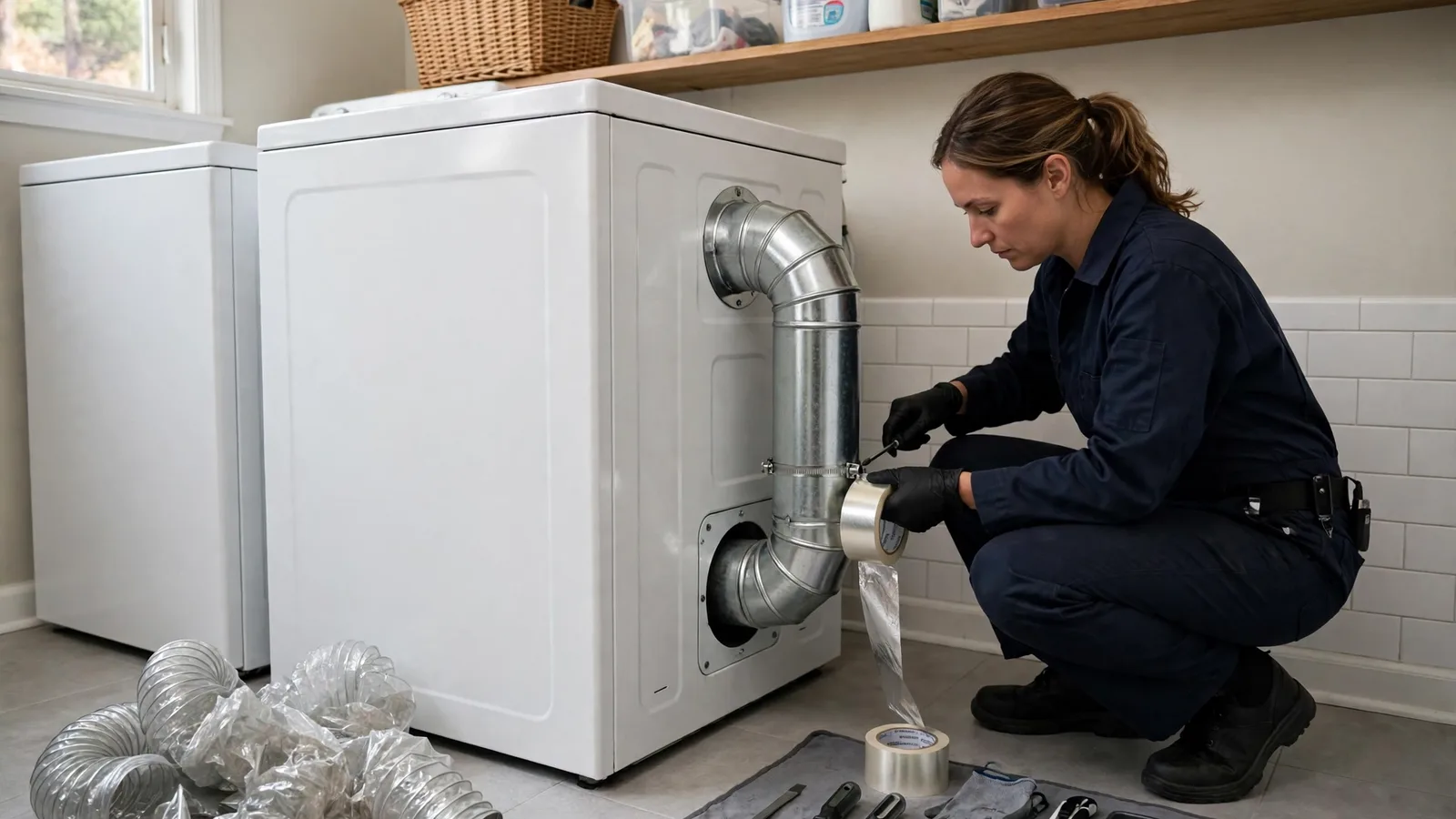
A vent line can look fine from the laundry room and be quietly broken everywhere else: a joint popped apart inside a wall, a flex hose crushed flat behind the dryer, a section sagging full of damp lint. Every gap leaks hot, moist air — and lint — into walls, ceilings and crawl spaces instead of sending it outside.
Our repair visit starts with finding the fault, not guessing at it. We trace the run, check airflow at the cap, and open up the accessible sections. Then we fix what is actually wrong: re-connecting and sealing joints, replacing crushed or torn sections with proper rigid or semi-rigid metal, and re-supporting runs that have sagged out of line.
What's included
- Disconnected joints located, re-connected and foil-sealed
- Crushed, torn or kinked sections replaced with metal duct
- Sagging runs re-supported so lint stops settling in low spots
- Leaks into walls and ceilings stopped at the source
- Full airflow test at the exterior cap before we leave
Book Your Vent Cleaning
Tell us what you need and we'll call you back to confirm. Rather talk now? (855) 640-0404 — answered 24/7.
How it works
Our Process
Trace & test
Airflow readings and a walk of the full run tell us where the line is losing its seal or its shape.
Expose the fault
We access the problem section — behind the dryer, in the basement ceiling, attic or crawl space.
Repair or replace
Sound sections are re-sealed; failed sections are replaced with rigid or semi-rigid metal and proper clamps — never tape alone.
Prove the fix
The dryer runs and the cap gets a final airflow check, so the repair is demonstrated, not described.
Questions
Dryer Vent Repair — FAQs
A laundry room that gets hot and humid while the dryer runs, a burning or musty smell, lint appearing around the dryer or on the floor behind it, and drying times that stay long right after a cleaning all point to a break, crush or leak in the line.
Often, yes — many faults sit at accessible joints near the dryer or at the exit. If a section is truly buried, we will show you exactly where it is and talk through the honest options before any wall is opened.
No — standard duct tape dries out and lets go with dryer heat. We use proper clamps and UL-listed foil tape rated for the job, so the seal lasts.
Very likely. A new dryer pushing into a crushed or disconnected line performs like an old one. The vent is the first place to check — and the cheaper fix.