
Blog · 2026-11-20
Commercial Laundry and Multi-Unit Dryer Vents: A Property Manager's Guide
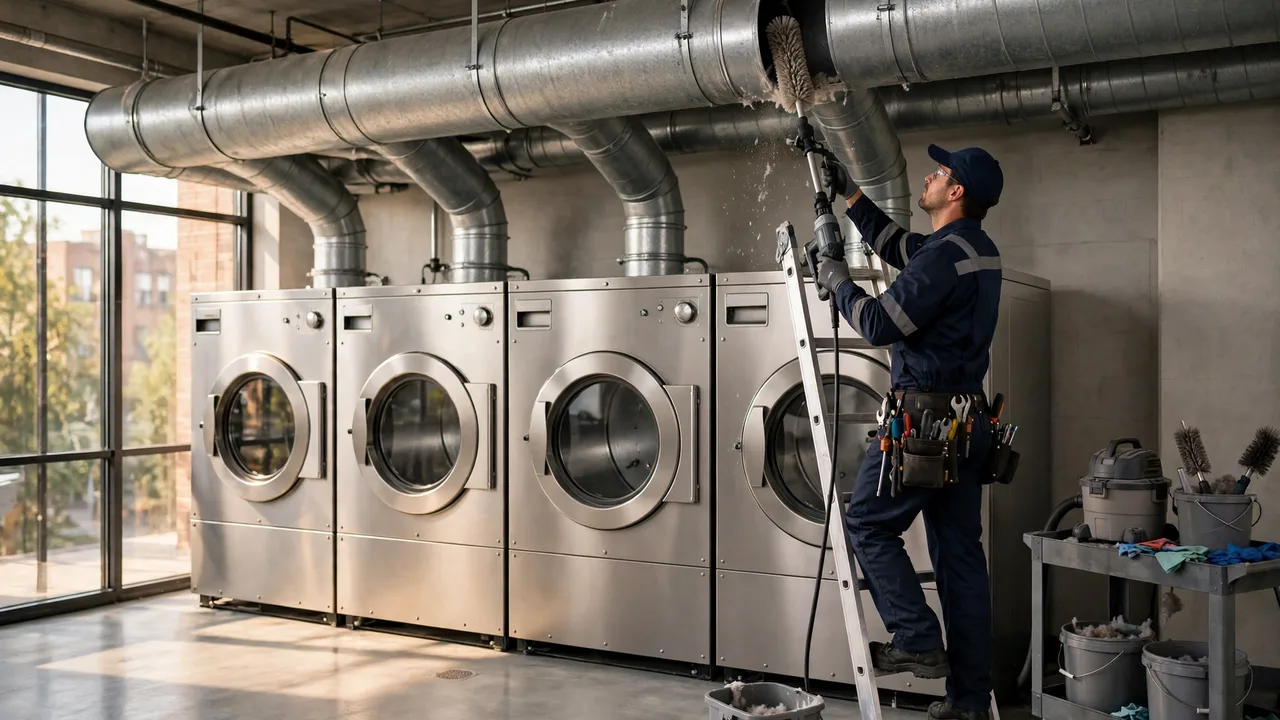
The fast answer: a commercial or multi-unit laundry vent is not a bigger version of a home vent — it is a shared system that loads with lint many times faster, serves many machines at once, and fails in ways that take whole laundry rooms down with it. Property managers across MD, DC and VA should treat it as building infrastructure: cleaned on a documented schedule based on load volume, checked at the manifold and the exterior termination, and recorded machine by machine, so insurer and inspector questions are answered with paperwork, not memory.
Why commercial vents load up so much faster
A home dryer runs a handful of loads a week. An apartment laundry room, a hotel housekeeping laundry, or a laundromat runs machines all day, every day — and every load sends lint past the traps into the vent system. The routing is different, too. Instead of one short run outside, commercial dryers usually feed into a shared manifold and a main trunk that may cross the building, turn through several elbows, and climb to a roof termination. Every foot of that trunk and every machine tied into it adds lint to the same shared passage. When that passage narrows, it does not slow one family's towels. It slows every machine on the line at once.
The failure pattern managers actually see
Commercial vent problems rarely announce themselves as vent problems. They show up as dryers blamed and replaced while the real restriction sits in the trunk line behind them. They show up as a laundry room that runs hot and humid all day, cycle times creeping longer week by week, machines tripping thermal limits, and a steady drip of complaints — residents reporting damp clothes, housekeeping falling behind on linen, laundromat customers paying for a second cycle. By the time a burning smell appears in a shared laundry room, the lint load in the system is well past due. According to the U.S. Fire Administration, clothes dryers are involved in thousands of fires in American homes every year, and failure to clean is the leading factor. In a multi-unit building, that risk sits in a shared wall or ceiling, serving dozens of households at once.
Volume decides the schedule — not the calendar alone
A home vent on an annual rhythm is sound guidance. A commercial system needs its interval set by throughput. A small apartment laundry room with a few machines and light use may hold a schedule close to a home's. A busy laundromat, a hotel laundry, a senior living facility, or a student housing laundry room can load a shared trunk in a fraction of that time. The honest way to set the interval is evidence: clean the system fully, measure the airflow at the termination and at the machines, then check how fast lint is accumulating at the first follow-up and set the recurring schedule from what the building actually produces. Our commercial and multi-unit programs are built exactly that way — recurring visits set by the building's volume, not by a one-size calendar.
What a proper commercial cleaning actually covers
It is more than brushing one duct. A complete service works the whole path the air travels: each machine's connection and transition duct, the manifold where the individual runs join, the full length of the main trunk, and the exterior termination — wall cap or roof exit — where lint packs and dampers stick. Connections get checked for crushes, separations and the wrong materials; a length of plastic or thin foil flex hiding behind one machine loads the shared system just as surely as lint does. Where a long trunk genuinely cannot move air on the dryers' push alone, a dryer-rated booster fan may belong in the conversation, and where the routing itself is the problem, rerouting is the permanent fix. The visit finishes the way a home visit does, scaled up: airflow proven at the termination, with the machines running.
Documentation is part of the service
For a manager, the record matters almost as much as the cleaning. Insurers ask about dryer vent maintenance after incidents, fire inspectors ask during walkthroughs, and boards ask when a laundry room starts generating complaints. A proper commercial visit leaves a service record behind: the date, which machines and which sections of trunk were cleaned, what was found — a crushed connection, a failed damper, birds nesting at a shared cap — and what was corrected or still needs a repair. If your building has never had its laundry vents surveyed, a lint and fire-hazard inspection is the right first step. Ours is visual and airflow-based only: we look at the connections, materials, manifold and termination, and we measure airflow while the machines run. No lab testing, no guesswork — just a straight account of what the system needs.
Between visits: what your staff can watch
Your team sees the laundry room every day, and the early signs are visible without tools. Dry times creeping up across several machines at once points at the shared trunk, not at one tired dryer. Lint dusting the floor behind the machines or heaped at the exterior termination means the system is shedding its load. A laundry room that feels hotter and more humid than it used to is exhaust backing up indoors. And the outside check works here too: with machines running, the termination damper should swing wide on a strong stream of air. Protect that exit with a dryer-vent-rated bird guard — never a fine screen, which clogs with lint and strangles the whole line. When two or three signs line up, do not wait for the scheduled date; move the cleaning up.
Managing a laundromat, hotel, apartment community or shared laundry room in MD, DC or VA? Call Eagle Dryer Vent Cleaning at (855) 640-0404 — answered 24/7 — or send the lead form on this site. We will survey the system, set a schedule based on your building's real volume, and leave documentation your files can stand on.
Want us to check your vent?
Book a cleaning or a fire-hazard inspection — airflow measured, evidence shown, straight answers.