
Blog · 2026-11-24
Second-Floor Laundry? Your Dryer Vent Works Harder Than You Think
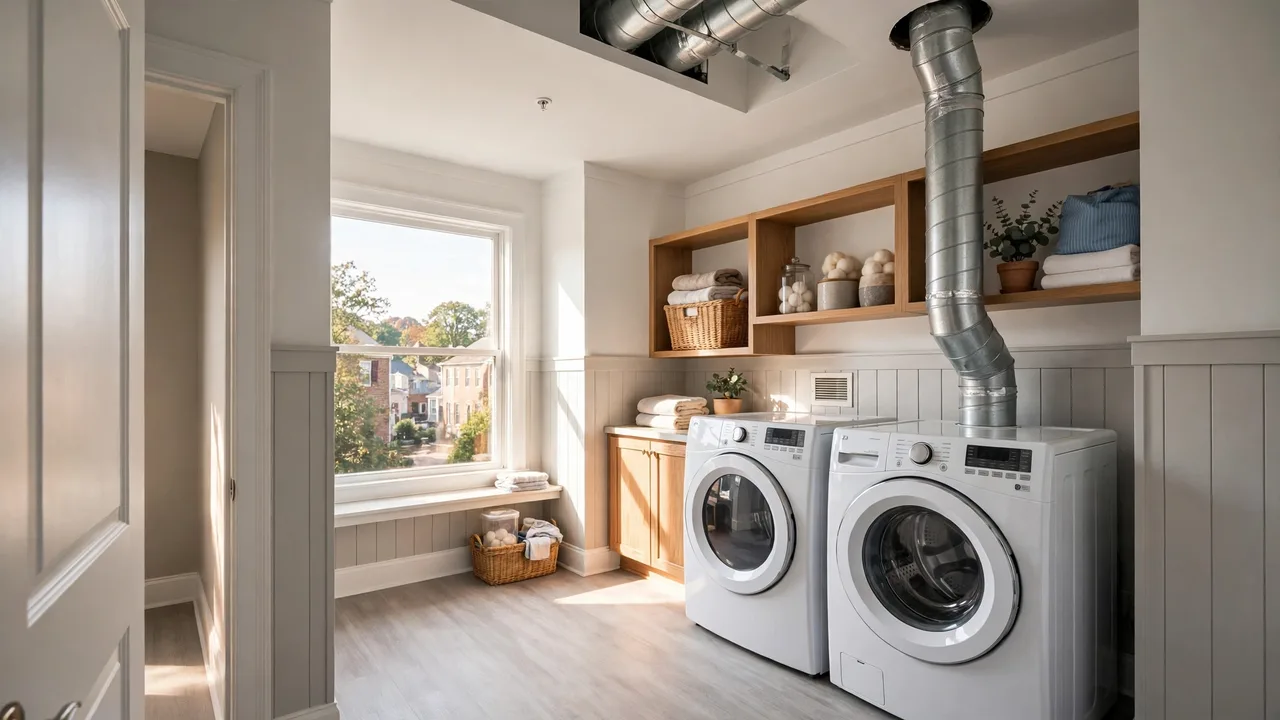
The fast answer: a second-floor laundry room almost always means a longer dryer vent run — up through a wall, across a ceiling or attic, and often out through the roof. Every extra foot and elbow adds resistance, lint settles faster in a run you cannot see, and the warning signs show up later because the cap is out of sight. Second-floor vents are not a problem by themselves, but they earn a strict annual cleaning rhythm and an airflow check you can trust.
Why builders moved the laundry upstairs — and the vent paid for it
Upstairs laundry is a genuinely good idea: the clothes live upstairs, so the laundry should too. Builders across Maryland, DC and Northern Virginia have put laundry rooms on the bedroom level for years. What the floor plan does not show is the vent's commute. A first-floor dryer on an outside wall may vent out in a few straight feet. An upstairs dryer often sends its exhaust down, up or sideways first — through a wall cavity, along a ceiling, sometimes into the attic and out the roof — before that air ever reaches daylight.
Length, climbs and hidden elbows
A dryer dries by moving hot, moist air out of the house, and it is not a powerful fan. Every foot of duct adds resistance and every elbow adds more, so a long upstairs run starts life closer to the dryer's limit than a short wall exit. Vertical sections add their own behaviour: as exhaust climbs it cools, moisture condenses on the duct walls, and damp lint sticks instead of blowing clear. Elbows hidden inside walls and ceilings are the collection points — air slows there, turns there, and drops its lint there, in places no one will ever see without opening the structure.
The signs are quieter upstairs
A ground-floor vent announces trouble: you walk past its cap, you see lint heaped at the hood, you notice the flap barely moving. An upstairs vent's exit is usually a roof cap or a high wall cap — out of sight from the yard and easy to forget entirely. So the evidence arrives indirectly. Drying times creep up on loads that used to finish in one cycle. The upstairs laundry room or closet runs hot and humid, and that moisture is being pushed into a smaller, more enclosed space. A musty smell near the laundry closet can mean a joint has separated inside the wall and is venting warm, moist air — and lint — into the structure instead of outside.
Moisture matters more on the second floor
Every load sends the water from wet clothes somewhere. A healthy vent sends it outside. A restricted or separated upstairs vent sends part of it into wall cavities, ceiling spaces or the attic — rooms and structures that sit directly over your living space. Over a season that shows up as peeling paint near the laundry closet, a ceiling stain below the run, or a closet that never quite smells fresh. It is one more reason an upstairs vent deserves evidence, not assumptions: our lint and fire-hazard inspection is visual and airflow-based only — we look at the connection, materials and routing as far as they can be seen, and we measure airflow at the exterior termination while the dryer runs. We do not claim lab testing.
What a proper cleaning looks like for an upstairs run
The work is the same discipline as any honest visit, carried further. The dryer comes out and the transition hose behind it is checked — metal, short, uncrushed, properly clamped. Then a full-line cleaning works the entire run with rotary brushes and a vacuum, from the dryer connection through every elbow to the termination, because the worst buildup on an upstairs run is usually mid-route or at the top, beyond the reach of any household tool from either end. The cap — roof or high wall — is accessed safely, opened, cleared of packed lint and checked for a damper that swings freely. If birds have found that high cap, nest material comes out and a dryer-vent-rated bird guard ends the repeat visits.
When cleaning is not the whole answer upstairs
Sometimes an upstairs line is cleaned, sound — and still slow, because the run is simply long. That is the honest territory of two options. A dryer-rated booster fan installed in the line can give the exhaust the extra push a long climb needs. Or, where a shorter route genuinely exists — a nearer wall, a straighter path — rerouting the vent solves the problem at its root. A crushed section or a separated joint found along the way is a straightforward repair. Which answer fits is decided by the airflow measured on a clean line, not by preference.
Your part: the checks that still work from inside
You cannot watch a roof cap swing from the ground, but you are not without gauges. Clean the lint trap after every load and wash the screen if water pools on it instead of passing through. Time a standard towel load now and write the time down — a steady climb over the season is your warning. Note a laundry room that runs hotter or more humid than it used to. And hold the annual rhythm without negotiation: according to the U.S. Fire Administration, clothes dryers are involved in thousands of fires in American homes every year, and failure to clean is the leading factor. A vent you cannot see deserves that discipline more, not less.
Laundry on the second floor of your MD, DC or VA home, and no idea when the vent was last cleaned all the way to its exit? Call Eagle Dryer Vent Cleaning at (855) 640-0404 — answered 24/7 — or send the lead form on this site and we will call you back to confirm a time to clean the full run and prove the airflow at the cap.
Frequently Asked Questions
Length and layout. An upstairs dryer usually vents through a longer run with more elbows, often climbing or crossing a ceiling or attic. Every foot and turn adds resistance, and damp lint sticks as the exhaust cools on the climb.
Use the inside evidence: drying times creeping up on loads that used to finish in one cycle, a laundry room or closet that runs hot and humid, and a musty smell that can point to a separated joint venting into the wall.
Not safely. High caps and roof work are not a DIY check. Keep the inside evidence honest instead — clean the trap after every load, time a standard towel load as your baseline, and hold the annual cleaning rhythm.
The run itself may be too long for the dryer alone. The options are a dryer-rated booster fan in the line, or rerouting if a shorter, straighter route exists. An airflow measurement on a clean line tells you which fits.
Want us to check your vent?
Book a cleaning or a fire-hazard inspection — airflow measured, evidence shown, straight answers.